
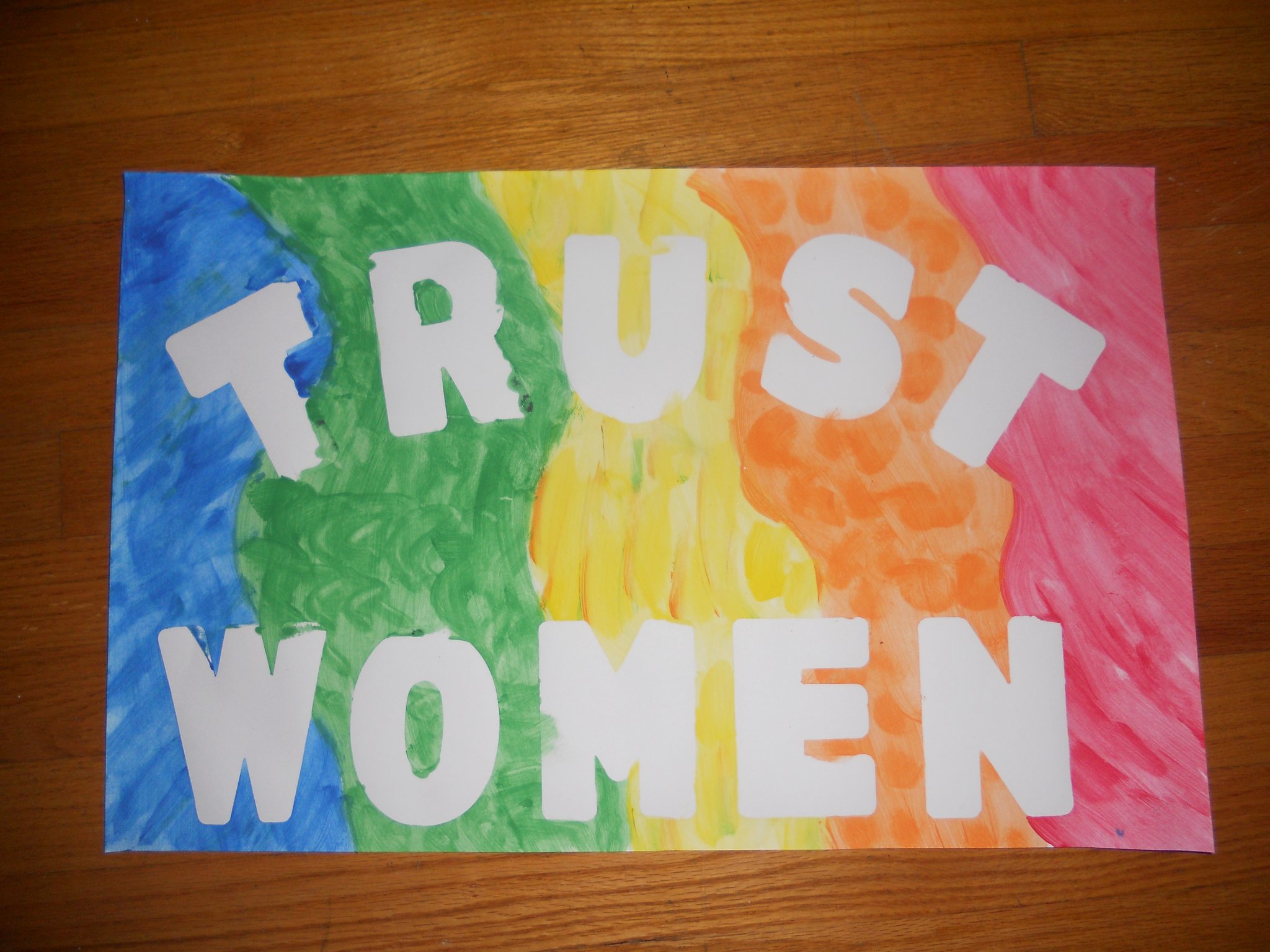
Anarchy provides a new lens through which to view feminist issues such as:
- Power Relations
- Bodily Autonomy – reproductive rights, abortion, sexual preferences
- Hierarchy – Through it’s staunch opposition to hierarchy, anarchy advocates for the presence of more women in existing power structures while working toward the redistribution of power and the creation of more egalitarian structures.
And critique issues such as:
- Heteronormativity
- Unquestioned customs and traditions
Most importantly, anarchy provides a theoretical framework for experimenting with the practical application of radical ideas. A reexamination of anarchist principles has strong implications for our work and our lives, and I find it helpful to pick and choose pieces that make sense to us as individuals as we seek to embody our fullest expression in service to our communities. This is an explanation as to why it works for me, first written in 2012 and ever so slightly modified for 2026.
I first learned of anarchist feminism through casual readings of Emma Goldman and Luisa Capetillo. Goldman’s Was My Life Worth Living and Capetillo’s How Poor Women Prostitute Themselves graced the pages of the Aunt Lute Anthology of U.S. Women Writers, and they spoke directly to my soul. Upon further reading, I learned that anarchist feminist ideology provides a theoretical justification for exploring radical theories and living in accordance with those theories in the face of societal disapproval – particularly for women who defy norms of feminine expression. Perspectives through which to overcome the disappointment of our loved ones when we choose to live with agency are liberatory and practically useful.
Anarchist feminist thought focuses on manifestations of power and hierarchy — emphasizing the idea that power has its own logic — and views dominance as the source of all social ills. All arbitrarily imposed hierarchies, then, represent both a vast abuse of power and a barrier to positive social evolution, including patriarchy and its infinite intersectional manifestations. This is the key lens of perception for anarchist feminists. Despite anarchy’s pop culture connection to violence and destruction, some proponents are much more likely to express the meaning of anarchy to be love and liberty.
Some people explain anarchism as a doctrine of crime and violence; however, millions of human beings have been burned in the name of Christ; thousands were guillotined in France in 1893 in the name of liberty. Anarchy did not commit those crimes; that some fanatic has erased a Carnot, a Canovas, a Humbert, a McKinley from the scene, these are isolated cases and furthermore, they are not taught in any institution; they are pardonable. Anarchists like Ravachols, Pallas, and Angiolillos are few, but the Torquemadas and the Louis IXs multiply with an astounding ease.
Luisa Capetillo
Anarchy is particularly opposed to hierarchy at all levels of social interaction. Anarchist women during the height of anarchist debate in the United States (1870-1920), in particular, argued that women and men should share equally in existing power structures, while consistently working toward the ideal of an egalitarian society. Essentially humanist, early anarchist women refused to give in to the arguments of the first wave suffragists. Instead of emphasizing difference and focusing on women’s [alleged] moral superiority in an effort to obtain public sphere privileges, anarchist women stated that their sheer humanity was the only argument required for such privileges.
Anarchist feminists, despite their various intersectionalities and different degrees of acceptance of individualist anarchism compared to communist anarchism, all agreed on one thing:
Marriage or no marriage, a woman is not and cannot be free, unless she is economically independent. Unless she can provide for her own needs, she is a man’s slave in some form or degree (it might be in a very civilized form, by the way), be he her legal or illegal lover or husband.
John Beverly Robinson
Anarchist women had different ideas about how to achieve economic independence. Some argued for collective housing for all or separate housing for men and women, arguing it would allow for women’s psychological independence; others argued for equal responsibility in child rearing and a relaxing of societal mores regarding sexuality. Still others saw voluntary motherhood as the most important factor determining women’s economic independence, and anarchist women were among the first to argue in favor of contraception. Most anarchists agreed that men and women deserved equal pay for equal work.
Anarchy opposes organized religion because most religions function to teach women about their naturally subordinate position to men. It is also a moral authority that operates in a hierarchical structure. The problems here are exponential and obvious.
That the centralization of power, whether in the Church or in the State, is dangerous to civil liberty and to individual rights, and … must be constantly and firmly opposed, … that the first duty of every individual is self-development and that morality is not theology … that right is right and wrong is wrong, not because any being in the Universe so declares, but in the nature of things, the origin of right being in truth and not in authority.
Matilda Joslyn Gage
Anarchist feminist thought was the first feminist lens I found that aligned with my values as a young mother. I have a strong, inherent disdain for arbitrary authority and any abuse of what may be considered even legitimate authority. I grew up in the south, where protestant ethics permeated social and institutional relations, strangers found it appropriate to tell me women should be seen and not heard and I was perpetually sexualized and told my flesh was sinful. Due to the context of my upbringing, I came to understand Christianity to be a primary source of women’s daily oppression and the continuation of misogynist worldviews. Further, I embrace an enmeshed understanding of individualism. To the extent that my unique consciousness seeks creative expression and meaningful connection, I enjoy being an independent, agentic human, and I believe that we should each seek our own highest unique forms so that we can contribute our gifts to our communities. Abortion is a fundamental human freedom rooted in the sanctity of individual choice. Humans should live free and accountable within their communities. Cooperation over competition any day. Partnership over domination.
Anarchist feminists’ focal point of women’s economic independence is forever relevant. We now live in a post-Roe era. The Heritage Foundation openly fucks around purporting to “save the family.” Sustained resistance is necessary. Young women must learn history. Oppositional strategies rooted in conscious awareness must be presented as alternatives. My drive to go to college and before all else become financially independent originated in the years I spent watching my mom be at the mercy of men for stability. It is dehumanizing. I refuse that life. I refuse it for my daughter and yours.
The nuclear family itself is purposeful propaganda that helps to define heterosexual relationships as normal. The nuclear family is forced by the church and rewarded by the state. Decisions about personal relationships do not need to be sanctioned by any institutional authority. Anarchy’s free love theories fit in here and are much more broad than history gives them credit for. Without advocating for or against promiscuity, it allows each individual more personal freedom, and very importantly, it allows women the space to develop psychological, social and economic independence. Alternative family structures, households and lifestyles should be supported by our tax structures, with an ultimate focus on a foundational standard of living and well-being for all humans, especially our children.
We love each other now and that is enough. We will not lose the happiness of the present by being anxious about the future. As long as love lives of his own free will we will enjoy him and be as happy as we are now. But if he should ever wish to leave us, we would not try to force him to stay, for love compelled is not worth having.
Florence Finch Kelly
I find the biggest weakness of anarchy to be its insistence on living according to nature. Nature is a loaded term. Many destructive actions have been normalized and justified in its name, while in reality, perceptions of what is natural are highly subjective. At the turn of the twentieth century, anarchist men spoke of freedom while living lives dependent upon women’s labor — because it was deemed natural for women to care for home and children. Unable to see the contradiction in their logic or listen to the demands of their partners, anarchist women were better able to see the sexist injustices of their day. There will always be contradictions and blind spots. I encourage you to first excavate them from within yourself. Think critically about what you’ve been taught to see as natural.
Anarchist feminism is a bold philosophical framework for rejecting ethics of domination, abuses of power and arbitrary authority, which are the root of all social ills. It opposes any and all institutions that presume to lead humans like sheep into following dogma that is not explicitly endorsed by one’s own consciousness. And it provides historical examples and theoretical frameworks for rejecting coercion, tradition and social pressure to conform to norms of domination.
I hold fast to my convictions, being certain that only in a society where no human being will rule over another, can there be true freedom.
Mollie Steimer
Leave a Reply